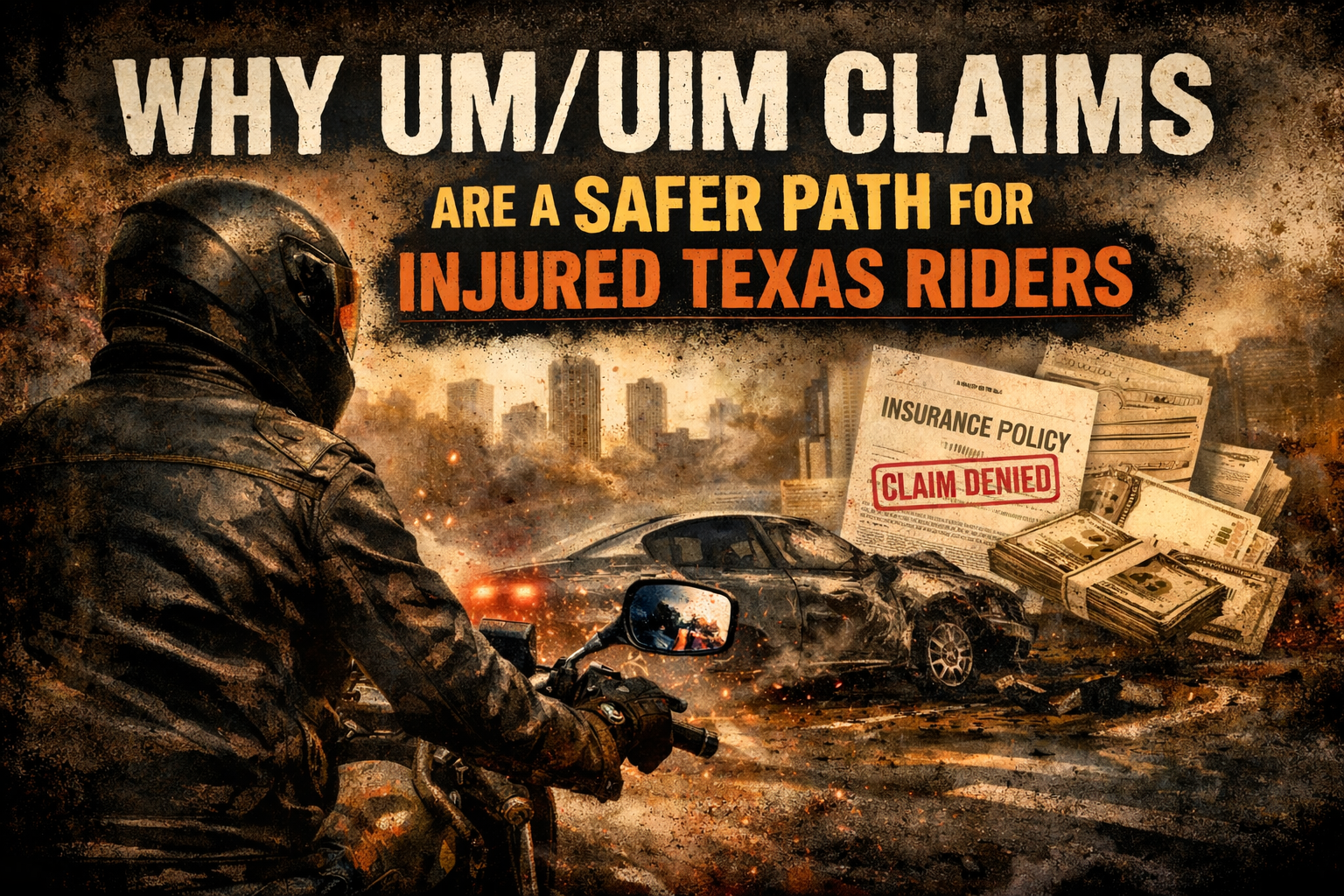
After a motorcycle crash, most riders assume the only path to recovery is going after the at-fault driver’s insurance company. That is usually the first move. But when the driver who caused the wreck has little coverage—or no coverage at all—your own Uninsured/Underinsured Motorist coverage may end up being the more reliable road.
That surprises a lot of people.
The reason is simple: a claim against the other driver is a tort claim, but a UM/UIM claim is a contract claim. That shift matters. A lot.
When you are dealing with the at-fault driver’s insurer, you are dealing with a company that does not work for you, does not protect you, and does not owe you loyalty. Their job is to protect their insured. That means delay, denial, blame-shifting, and lowballing are all part of the game.
A UM/UIM claim is different. You paid premiums for that protection. Your carrier made a promise to you in exchange for those payments. That changes the legal relationship and, in many cases, makes the claim more dependable.
Third-Party Claims Are Adversarial by Design
In a third-party injury claim, you are essentially a stranger to the insurance company. The insurer for the careless driver owes its duty to its policyholder, not to the injured motorcyclist.
That means the company can challenge liability, question your injuries, drag out negotiations, and fight the value of the case without owing you any duty of good faith. Their mission is to protect the driver who caused the crash and to save the company money.
That is one reason injured riders often feel like the deck is stacked against them. Because it is.
UM/UIM Coverage Creates a Direct Legal Duty
A UM/UIM claim is first-party coverage. That means the policy belongs to you. You paid for it. The insurer is not defending some careless stranger. It is dealing directly with its own insured.
That matters because first-party insurers in Texas owe a duty of good faith and fair dealing. They may still dispute the value of a claim. They may still raise defenses. But they cannot handle your claim with the same indifference that a third-party carrier can show without risking extra-contractual exposure for bad faith conduct.
In plain English: they still may fight, but the rules are different.
Texas Law Gives First-Party Claims More Leverage
Texas law also gives UM/UIM claims something most third-party claims do not have—real statutory deadlines.
Under the Texas Prompt Payment of Claims Act, insurers handling first-party claims must move within specific timelines. Generally speaking, they must acknowledge the claim, investigate it, decide whether to accept or reject it, and then pay promptly once the claim is accepted.
If they do not, the insurer may face statutory interest and attorney’s fees.
That is a serious incentive to take the file seriously.
By contrast, third-party liability carriers are not subject to that same prompt-payment framework when they are negotiating with an injured claimant. In those cases, delay is often just another defense tactic.
Here is the basic timeline riders should understand:
| Requirement | Deadline Under Texas Prompt Payment Rules |
|---|---|
| Acknowledge claim | 15 days after receiving notice |
| Accept or reject claim | 15 business days after receiving requested information |
| Final payment | 5 business days after acceptance |
The point is not that insurers always behave perfectly. They do not. The point is that first-party claims come with legal teeth that can create pressure to move the file instead of letting it sit forever.
The Brainard Rule: A Hurdle, But Also a Source of Certainty
Texas riders should also understand one important complication in UM/UIM law. Under Brainard v. Trinity Universal Insurance Co., a UIM insurer’s duty to pay is generally not triggered until the liability of the underinsured driver and the amount of damages have been established.
At first glance, that sounds like bad news. It can mean an extra legal step.
But there is another side to it.
Once liability and damages are fixed—whether through judgment, adjudication, or a properly resolved underlying claim—the UM/UIM carrier has much less room to play games. The claim becomes more concrete. The amount is no longer just a negotiation number thrown around in letters and phone calls. It becomes a legally established obligation.
That can make payment slower at the front end, but often surer at the back end.
UM/UIM Helps Riders Avoid the “Judgment Proof” Problem
There is another harsh truth in injury law: sometimes you can win the case and still lose financially.
If the driver who hit you carries only minimum limits and has no meaningful assets, a large verdict may look good on paper and still be impossible to collect. A rider with catastrophic injuries can end up staring at a recovery that falls far short of the real damages.
UM/UIM coverage helps solve that problem.
Instead of depending entirely on the financial weakness of the careless driver, you are turning to an insurance company that has a contractual obligation to pay covered damages up to the limits of the policy. The solvency risk is dramatically different. You are no longer chasing a broke defendant. You are enforcing a contract against a well-funded insurance carrier.
That does not mean the insurer will write a check willingly. It means there is actually money there to pursue.
A More Direct Path in Texas
Texas procedure has also become more practical in some UM/UIM cases. Following Allstate v. Irwin (2021), policyholders may in some situations proceed directly against their UM/UIM carrier through a declaratory judgment process to establish liability and damages, rather than always having to fully litigate against the at-fault driver first.
That can streamline the process and remove unnecessary steps, especially where the real dispute is over what the rider is legally entitled to recover under the policy.
Why This Matters for Motorcyclists
Motorcycle wrecks often produce serious injuries: broken bones, surgeries, traumatic brain injuries, road rash, lost wages, permanent impairment, and long recoveries. Those cases can quickly outgrow a careless driver’s minimum liability policy.
That is why UM/UIM coverage is so important for riders. It is not just another line item on a declarations page. In the right case, it may be the coverage that stands between an injured motorcyclist and financial disaster.
A third-party claim may still be necessary. Often it is. But riders should not overlook the legal power of a first-party UM/UIM claim under Texas law. The rights are different. The duties are different. And the path to actual payment may be far more dependable.
Here is the side-by-side comparison:
| Feature | Third-Party Claim | UM/UIM Claim |
|---|---|---|
| Legal basis | Tort (negligence) | Contract (policy agreement) |
| Duty of good faith | None owed to injured rider | Owed to insured |
| Prompt payment rules | No comparable first-party deadlines | Yes |
| Insurer’s main incentive | Protect at-fault driver | Honor coverage obligation |
| Solvency risk | High if defendant has low limits or no assets | Low because claim is against an institutional carrier |
The Bottom Line
When a negligent driver does not carry enough insurance, UM/UIM coverage may offer Texas riders something the third-party system often cannot: a more structured, more enforceable, and more collectible path to compensation.
Third-party claims are built on negligence law and adversarial insurance defense tactics. UM/UIM claims are grounded in contract law and backed by duties the insurer owes directly to its own insured.
That distinction can make all the difference.
If you ride in Texas and do not know whether you have strong UM/UIM coverage, now is the time to find out—not after a crash.
And if an insurance company is giving you the runaround after a wreck,
Call Deano
(832) 444-6085
JUSTICE WILL BE SERVED!