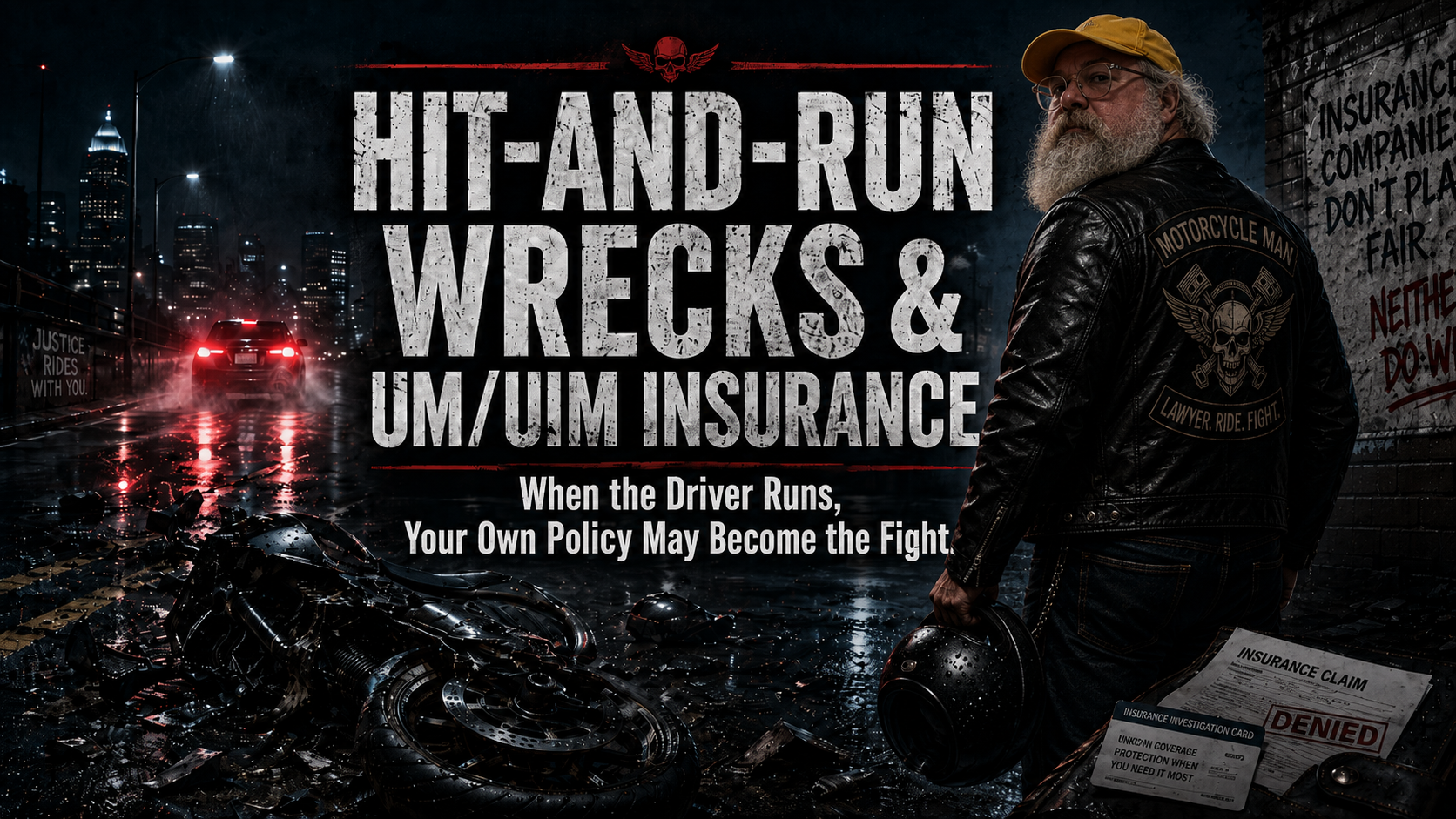
Hit-and-Run Motorcycle Wrecks and UM/UIM Insurance: When the Driver Runs, Your Own Policy May Become the Fight
Hit-and-run motorcycle wrecks are dirty.
A driver hits a rider, sees the damage, knows somebody may be hurt, and then does the lowest thing possible.
They run.
No name.
No insurance information.
No apology.
No accountability.
Just taillights disappearing while the rider is left with the pavement, the pain, the ambulance, the hospital bills, and the wrecked bike.
That is bad enough.
But then comes the second fight.
The insurance fight.
Because when the driver disappears, the rider may have to turn to their own insurance policy for help. That is where uninsured motorist coverage, underinsured motorist coverage, MedPay, or PIP may become critical.
And riders need to understand something right away:
Your own insurance company may not treat you like the good customer from the commercials.
People Hit. People Run. Riders Need Proof.
In a car-to-car crash, the vehicles often stay at the scene.
In a motorcycle crash, the driver may still be able to drive away.
They have doors, bumpers, airbags, and steel.
The rider has gear, a helmet, and the reality of the pavement.
A hit-and-run driver may know exactly what happened. They may know the rider is hurt. They may know they caused the wreck. But instead of stopping, they gamble that nobody got the plate, nobody saw the crash, and nobody can prove what happened.
Sometimes all the rider has is “white truck,” “silver SUV,” or “dark car.”
That is not enough.
Evidence matters.
Cameras matter.
Witnesses matter.
Fast action matters.
Be Your Own Best Private Investigator
Deano is right about this one: riders have to protect themselves before the crash ever happens.
Put a camera on your motorcycle.
Better yet, put two.
Front and rear.
Because after a hit-and-run, you may not be able to gather evidence. You may be hurt. You may be in shock. You may be in an ambulance. You may not remember the make, model, direction of travel, or license plate.
A motorcycle camera can catch what your memory cannot.
The vehicle.
The lane.
The impact.
The plate.
The driver running.
That footage can turn “somebody hit me” into proof.
And proof is what gets cases moving.
When the Driver Is Gone, UM/UIM Coverage May Matter
If the hit-and-run driver is never found, that does not automatically mean the rider is out of options.
Uninsured motorist coverage may help when the at-fault driver cannot be identified or has no insurance. Underinsured motorist coverage may matter when the driver is found but does not have enough insurance. Other parts of the policy, like medical payments coverage or personal injury protection, may also help depending on the coverage purchased.
This is why riders need to know what is in their policy before the wreck.
Not after.
Because after the wreck, it is too late to wish you had better coverage.
UM/UIM is not some boring insurance add-on.
For motorcyclists, it can be the difference between having a path forward and getting left holding the bag.
Your Own Insurance Company Can Still Fight You
This is the part riders do not always expect.
You paid premiums.
You had coverage.
You did nothing wrong.
The driver ran.
So your own insurance company should step up, right?
Maybe.
But do not count on easy.
Insurance companies may question whether the hit-and-run happened the way you say it did. They may argue there is not enough proof another vehicle caused the crash. They may minimize your injuries. They may blame gaps in treatment. They may act like the rider must have been speeding, distracted, or somehow responsible.
That is why a UM/UIM claim still has to be built like a real injury case.
You need the crash documented.
You need medical treatment.
You need evidence.
You need witnesses.
You need photos.
You need video if it exists.
You need the insurance policy reviewed.
And you need to be careful before giving any recorded statement.
What Riders Should Do After a Hit-and-Run Motorcycle Crash
If you are able, call 911 immediately.
Get medical help.
Tell the officer every detail you remember, even if it seems small. Vehicle color. Direction of travel. Type of vehicle. Partial plate. Damage to the vehicle. Stickers. Company markings. Anything.
Take photos of the motorcycle, your injuries, debris, skid marks, road conditions, traffic signs, and nearby businesses that may have cameras.
Look for witnesses.
Ask about dashcam footage.
Check nearby gas stations, apartments, storefronts, parking lots, traffic cameras, and doorbell cameras.
Report the claim to insurance, but do not hand them a recorded statement without understanding what is at stake.
And most importantly, do not wait around while evidence disappears.
Hit-and-Run Cases Move Fast Because Evidence Disappears Fast
The insurance company will not build the case for you.
Video may be overwritten in days.
Witnesses may disappear.
Vehicles may be repaired.
Debris may be cleaned up.
Memories may fade.
Police reports may be delayed, incomplete, or hard to track down.
That is why hit-and-run motorcycle cases need pressure early. The sooner the investigation starts, the better chance there is to find the driver, prove the crash, identify insurance coverage, and protect the rider’s claim.
The Driver Ran. Do Not Let the Insurance Company Run Too.
A hit-and-run motorcycle wreck can leave a rider feeling like nobody is accountable.
But the fight is not always over.
The driver may be found.
A camera may catch the plate.
A witness may come forward.
Your own UM/UIM coverage may apply.
Other insurance may exist.
But none of that happens by magic.
The case has to be pushed.
Because the driver already ran once.
Do not let the insurance company run from its responsibility too.
Call Motorcycle Man After a Hit-and-Run Motorcycle Wreck
If you were hurt in a hit-and-run motorcycle crash, do not assume you are out of options.
Motorcycle Man can help investigate the wreck, search for available video, review insurance coverage, deal with the insurance company, and fight for the compensation you deserve.
People hit.
People run.
Motorcycle Man fights back.
Call Deano and get the case moving.
(832) 444-6085
JUSTICE WILL BE SERVED!