Texas Motorcycle Claims
The Insurance Company Denied My Motorcycle Accident Claim—What Do I Do Now?
A denial letter is the insurance company’s position. It is not the final truth about your crash.
The envelope lands. The email arrives. The adjuster calls. Your motorcycle accident claim has been denied.
Maybe the insurer says its driver was not at fault. Maybe it claims you were speeding. Maybe it points to an exclusion buried in a policy. Whatever the wording, the message is designed to feel final.
It may not be.
First things first
What Does an Insurance Denial Actually Mean?
A denial means the insurer has decided—based on the information it reviewed, the policy language it applied, or both—that it will not voluntarily pay the claim right now.
It does not necessarily mean the insurer investigated every witness, found every camera, correctly interpreted the policy, or accurately reconstructed the collision. It does not mean a judge or jury agreed with the company. And it does not erase evidence that contradicts the adjuster’s conclusion.

Why claims get rejected
Common Reasons Motorcycle Accident Claims Are Denied
“Our Driver Was Not at Fault”
The insurer accepts its driver’s version and treats it as the default—sometimes before the rider can even give a full statement.
Alleged Rider Speed
“The motorcycle was speeding” is easy to say and harder to prove. Physical evidence, video, sightlines, and vehicle data may tell a different story.
Conflicting Statements
A rushed roadside remark or incomplete police narrative may be treated as settled fact even when it lacks context.
Missing Evidence
If footage, witnesses, photographs, or vehicle data have not been collected, the insurer may claim there is not enough proof.
Disputed Injuries
The company may argue that the crash did not cause the injuries, treatment was delayed, or a prior condition is responsible.
Policy or Coverage Problems
The insurer may rely on an exclusion, cancellation, excluded-driver provision, notice issue, or disagreement over who and what the policy covers.
Know what you are fighting
Liability Denial vs. Coverage Denial
Liability Denial
The insurer claims its driver did not cause the crash—or that the rider caused enough of it to defeat or reduce the claim.
The fight centers on how the wreck happened.
Coverage Denial
The insurer claims the policy does not cover the person, vehicle, event, or loss at issue.
The fight centers on the policy and the facts controlling coverage.
These are different disputes. Challenging the wrong one wastes time and can leave the real denial unanswered.
Bias with a business suit on
When Rider Bias Gets Disguised as a Liability Decision
Motorcyclists are still judged by stereotypes: reckless, aggressive, too fast, impossible to see. An insurer may never write the word bias in its file. It may simply give the driver every benefit of the doubt and the rider none.
That is why motorcycle cases cannot be handled like small car-accident claims. The story must be built from evidence before an assumption hardens into the official version.

Protect the proof
What to Save Immediately After a Denial
✓
The denial letter, envelope, email, and every attachment
✓
The full insurance policy and declarations page, if the denial involves coverage
✓
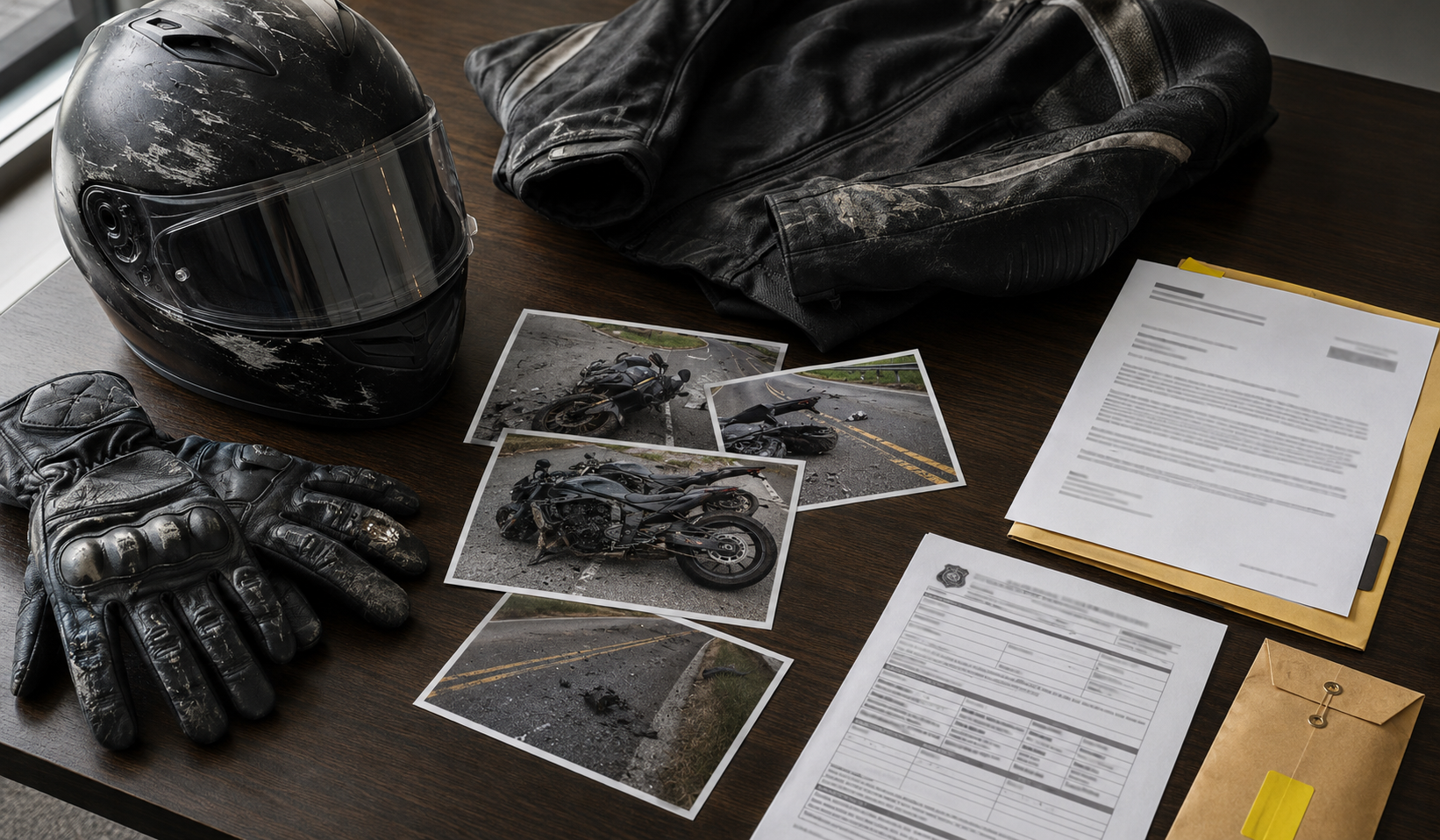
Crash photographs, helmet-camera footage, dash-camera footage, and nearby surveillance leads
✓
Witness names, telephone numbers, messages, and recorded recollections
✓
The crash report, incident number, diagrams, and any supplemental reports
✓
Medical records, bills, work restrictions, wage-loss records, and injury photographs
✓
Repair estimates, motorcycle photographs, damaged gear, and the motorcycle itself
✓
A written log of every adjuster call, voicemail, letter, and deadline
Do not feed the denial
Why Arguing With the Adjuster by Telephone Can Backfire
A rider who has just been denied naturally wants to call and set the company straight. But an emotional, unprepared conversation can create new statements for the insurer’s file without fixing the missing evidence.
Before giving another recorded statement or trying to explain every detail from memory, get clear on the exact reason for the denial. Preserve the letter. Request that the company identify the facts and policy provisions it relied on. Then decide how the denial should be challenged.
The next move matters
What to Do After Your Motorcycle Claim Is Denied
- 1
Read the Exact Reason
Do not settle for “claim denied.” Identify every stated factual, legal, and policy basis.
- 2
Stop Evidence From Disappearing
Video can be overwritten. Vehicles can be repaired or destroyed. Witnesses can become harder to find.
- 3
Build the Missing Record
Compare the denial with the crash scene, physical evidence, medical proof, witness accounts, and policy language.
- 4
Challenge It With Evidence
A focused written response should attack the actual reason for denial—not merely repeat that the claim is valid.
- 5
Prepare for Litigation
If the company will not change its position, a lawsuit may be the mechanism that puts witnesses under oath and evidence under subpoena.
Texas proportionate responsibility
The Insurer Says You Were Partly at Fault. Is the Claim Over?
Not necessarily. Under Texas law, a claimant is barred from recovering damages only when the claimant’s percentage of responsibility is greater than 50%. A claimant who is 50% or less responsible may still recover, although the damages are generally reduced by that percentage.
An adjuster’s fault percentage is not a court judgment. The facts still have to support it.
Rebuild the case
How a Motorcycle Lawyer Challenges a Denied Claim
A serious challenge starts by pulling apart the denial line by line. That may require locating independent witnesses, sending preservation demands, obtaining available video, inspecting the motorcycle and other vehicle, analyzing sightlines, reviewing electronic data, working with qualified experts, and connecting medical evidence to the mechanics of the collision.
For a coverage denial, the work may also require obtaining the complete policy, endorsements, notices, payment history, underwriting materials, and the insurer’s explanation of the specific provision it says defeats coverage.
The goal is not to argue louder. The goal is to make the denial harder to defend.
A Denial Does Not Stop the Clock
In Texas, the general limitations period for a personal-injury lawsuit is two years from the date the claim accrues, although exceptions can change the deadline. Continuing to negotiate with an insurer does not automatically preserve a lawsuit. Waiting can also cost you evidence long before the legal deadline arrives.
When talk is over
When a Lawsuit May Be Necessary
Sometimes the insurer reconsiders after new evidence exposes a weak denial. Sometimes it does not. A lawsuit can create tools that an informal claim does not: sworn testimony, subpoenas, document requests, inspections, expert analysis, and ultimately a decision by a judge or jury.
Filing suit is not proof that the case failed. It may be the step required to move the claim out of the adjuster’s closed file and into a process where the evidence has teeth.
The insurance company made its move.
Now Make Yours.
If your Texas motorcycle accident claim was denied, bring the letter. Bring the evidence. Bring the questions.
Get answers. Get moving. Get justice.
Legal disclaimer: This article provides general information, not legal advice. Deadlines, insurance rights, and available claims depend on the specific facts and policy language. Reading this article does not create an attorney-client relationship.